Hollywood Star’s Fiery Rant Ignites Debate Over Justice After Deadly Chicago Teen Shooting
Under the twinkling glow of holiday lights meant to herald joy and renewal, a nightmare unfolded on the bustling streets of downtown Chicago late on Friday, November 22, 2025, transforming a cherished Christmas tree lighting ceremony into a scene of unimaginable tragedy. As families bundled against the crisp autumn chill gathered in Millennium Park for the annual event—a tradition that draws thousands with its promise of festive cheer and communal warmth—gunfire shattered the evening, claiming the life of a 14-year-old boy and leaving eight others wounded in two harrowing, back-to-back shootings. The air, once alive with laughter and the scent of spiced cider, filled instead with screams and the acrid bite of panic, as crowds fled in terror near the iconic Chicago Theatre. In the chaotic aftermath, reports emerged of hundreds of juveniles clashing with police, hurling fireworks, mace, and even stun guns in a frenzy that left officers reeling and the city grappling with a stark question: How did a night of celebration spiral into such profound loss, and what does it say about the fragile threads holding our communities together?

The first shots rang out around 10:15 p.m. near the intersection of State and Randolph streets, just blocks from the park’s glittering centerpiece. Seven teenagers, ranging in age from 13 to 17, were struck in what police described as a brazen exchange amid a swelling crowd of young people spilling out from the ceremony. Witnesses, their faces pale under the sodium glow of streetlamps, recounted a scene straight out of a parent’s worst fear: kids in hoodies and sneakers, some as young as middle schoolers, suddenly scattering like leaves in a gale as bullets whizzed through the night. One mother, clutching her 12-year-old daughter close after the fact, told reporters through tears that she’d come for the lights, not the horror. “We were singing carols one minute, and the next, everyone was running for their lives,” she said, her voice breaking as sirens wailed in the distance. The victims were rushed to Northwestern Memorial Hospital, where surgeons worked through the night to mend wounds from stray rounds that pierced arms, legs, and torsos—miraculously, no fatalities in this initial volley, but the toll on young bodies and spirits was immediate and indelible.
Barely 20 minutes later, the second barrage erupted near Dearborn and Monroe streets, a stone’s throw away in the heart of the Loop. Here, the violence turned lethal: a 14-year-old boy, identified by authorities only as a local resident pending family notification, collapsed lifeless on the sidewalk, felled by multiple gunshot wounds to the chest. Another teenager was grazed in the arm, joining the tally of the injured and pushing the night’s grim count to nine souls forever altered. Cellphone videos, shaky and frantic, captured the pandemonium: a sea of fleeing figures, headlights flashing erratically as cars swerved to avoid the melee, and the distant pop-pop-pop of gunfire echoing off skyscrapers adorned with wreaths and garlands. One clip, shared widely on social media before being flagged for graphic content, showed a young man crumpling to the pavement, his friends’ cries piercing the din like shards of glass. Chicago Police Superintendent Larry Snelling, his face etched with the weariness of too many such calls, addressed the press in the early hours of Saturday, vowing a full investigation while decrying the “senseless cycle of violence that’s robbing our city of its future.” No arrests had been made by dawn, but sources within the department hinted at leads pointing to gang-related disputes spilling over from the crowd.
Yet, woven into this tapestry of grief was another layer of unrest: the specter of a juvenile-led disturbance that preceded and perhaps precipitated the shootings. As the tree lighting wrapped around 9:30 p.m., what began as an exuberant exodus of teenagers—estimates from police logs pegged the group at around 300 strong—devolved into disorder near the theatre district. Officers responding to reports of rowdy behavior were met not with compliance but confrontation: fireworks exploding like makeshift grenades, bursts of mace stinging the air, and stun guns—illegal for civilians in Illinois—wielded against badges in a blur of defiance. Bodycam footage released hours later showed officers dodging projectiles, one patrol car window shattered by a hurled bottle, as the crowd surged and scattered. “It was like a flash mob gone wrong,” one veteran cop confided to local outlets, his tone laced with frustration and a hint of fear. “These kids aren’t just kids anymore; they’re armed and angry, and we’re out there trying to keep the peace without escalating.” The clashes, while not directly linked to the gunfire, amplified the chaos, turning a festive night into a tinderbox where tempers flared and opportunities for tragedy multiplied.
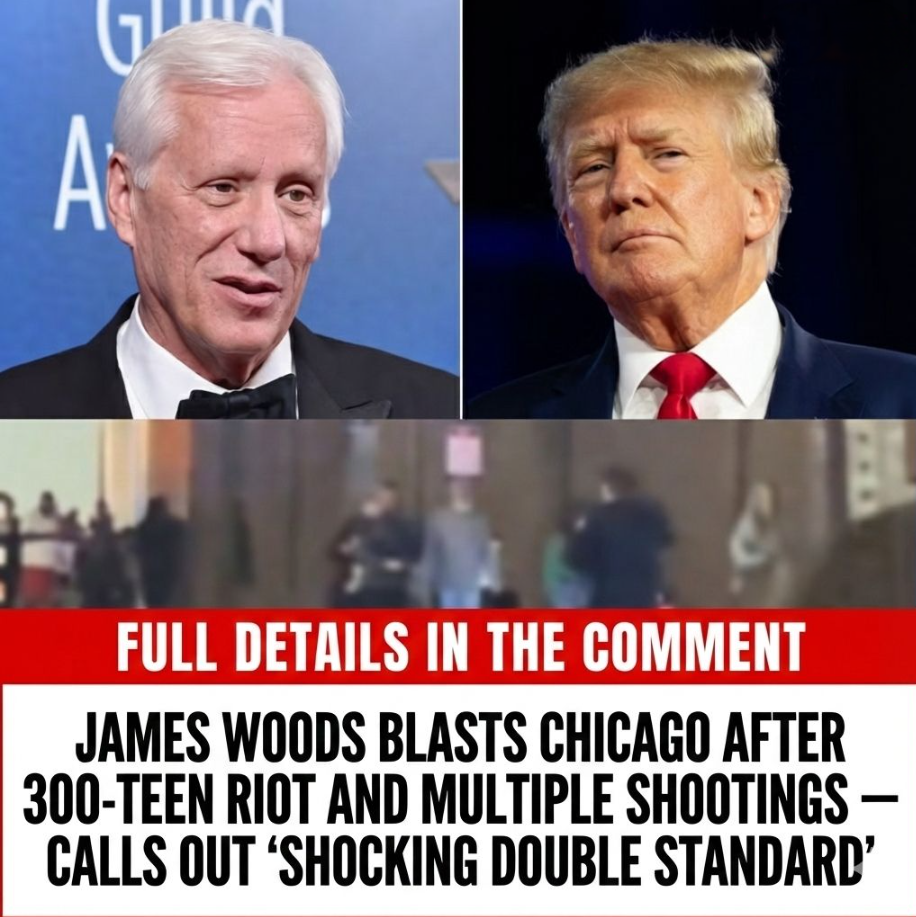
Into this maelstrom stepped James Woods, the veteran Hollywood actor whose sharp tongue and unfiltered conservatism have made him a lightning rod on social media. Long before the bullets stopped flying, Woods—known for roles in films like “Once Upon a Time in America” and a career spanning decades of gravitas—lit a fuse with a blistering post that ricocheted across X, amassing thousands of shares by midnight. Quoting a report on the riots, he didn’t mince words: “If an old white guy defends himself against a gang of hoodlums trying to rob and potentially murder him, he’ll go to jail for four years.” He pivoted sharply to the alleged perpetrators, painting a picture of leniency that stung like salt in the wound. “They’ll round up these ‘teens,’ then they’ll all walk free even though they’ve shot people with illegal guns,” Woods wrote, capping his missive with a stark indictment: “DEI is real. The double standard is real. 100%.” The post, hashtagged with nods to the incident and courtesy of commentator Collin Rugg, struck a chord with those weary of urban crime’s relentless drumbeat, but it also ignited backlash from corners decrying its racial undertones and oversimplifications.

Woods’ words, delivered with the precision of a man who’s seen Hollywood’s illusions up close, tapped into a raw nerve exposed by years of policy debates in Cook County. At the heart of his critique lies a contentious reality: Illinois’ juvenile justice system, reformed in 2017 to emphasize rehabilitation over incarceration, has led to thousands of young offenders being released pretrial or diverted from detention, even in cases involving firearms. Local advocacy groups like the Cook County State’s Attorney’s office reported seeking detention in 115 gun-related juvenile cases in the first 100 days of 2025 alone, a deliberate push amid rising scrutiny. But critics, including Woods, point to broader trends: in 2024, over 1,100 juvenile felony cases involving guns resulted in releases without overnight detention, per analyses from watchdog organizations tracking the Juvenile Temporary Detention Center’s intake logs. These aren’t abstract figures; they’re stories of second chances that sometimes circle back to tragedy, like the 16-year-old arrested last summer for a drive-by who was home by evening, only to be linked to another incident weeks later. Supporters of the approach, including juvenile justice reformers, argue it’s a compassionate pivot from the school-to-prison pipeline, citing studies showing detained youth are 20 percent more likely to reoffend harshly. Yet, in the wake of Friday’s horror, voices like Woods’ amplify the heartbreak of families who wonder if mercy for one comes at the expense of safety for all.
This incident, heartbreaking as it is, unfolds against a backdrop of shifting sands in Chicago’s crime landscape—one that’s more nuanced than the headlines often allow. Far from the relentless uptick some narratives cling to, 2025 has brought a marked decline in overall shootings and homicides, with police data showing a 33 percent drop in murders and over 30 percent fewer gun incidents through the first nine months compared to the prior year. Community violence intervention programs, bolstered by federal grants under the Bipartisan Safer Communities Act, have credited much of this progress to street outreach workers embedding in high-risk neighborhoods, mediating beefs before they boil over. In Englewood and Austin, where teen involvement once dominated stats, shootings involving minors fell 25 percent year-to-date, a quiet victory forged in late-night huddles and trust-building over shared meals. But pockets of peril persist: Labor Day weekend saw a 67 percent spike in such incidents, a stark reminder that progress is uneven, especially when illegal guns—trafficked from states with laxer laws—flood the streets at rates unchanged by broader trends.

For the victims’ families, these statistics offer cold comfort. The 14-year-old boy, whose name was released Saturday morning as Jamal Washington—a bright-eyed student at Whitney Young High School with dreams of becoming a chef—leaves behind a mother who collapsed in sobs at a vigil outside the hospital. “He was my everything,” she whispered to gathered supporters, her words carrying the weight of a grief that no policy debate can touch. Jamal had been at the tree lighting with cousins, snapping selfies under the lights, when the unthinkable intruded. His death, the 450th homicide in Chicago for 2025, underscores a poignant irony: while overall violence ebbs, the vulnerability of youth in “low-opportunity” zones remains acute, with studies showing kids there face risks up to 20 times higher than in affluent areas.It’s a disparity that fuels calls for holistic change—from expanded mental health services in schools to stricter tracing of ghost guns that arm the untrained and impulsive.
Woods’ outburst, for all its fire, lands in this emotional maelstrom with a mix of resonance and recoil. On one hand, it voices the frustration of residents like Maria Gonzalez, a Loop shop owner whose storefront was looted during the melee, her holiday displays trampled underfoot. “I’ve seen good kids lost to bad choices, and the system’s hands are tied,” she said, echoing Woods’ plea for equity in accountability. On the other, advocates like the Rev. Michael Pfleger, Chicago’s tireless anti-violence crusader, caution against broad brushes that stigmatize entire communities. “These are our children too—traumatized by poverty and absence, not inherent evil,” Pfleger urged in a Saturday sermon, his voice rising over a congregation heavy with mourning. The double standard Woods decries is real in perception, if not always in practice: self-defense cases involving elderly white defendants in Cook County have indeed drawn scrutiny, with high-profile trials like the 2023 Kyle Rittenhouse echoes lingering in judicial minds. But data from the state’s attorney shows juvenile gun cases increasingly funneled to diversion programs, with 70 percent avoiding formal charges if they complete counseling—outcomes that save souls but sometimes sow seeds of doubt in public safety.

As Saturday dawned gray and somber, the city stirred with resolve. Mayor Brandon Johnson, flanked by faith leaders and youth advocates, announced an emergency summit on gun violence prevention, pledging $5 million more for after-school programs in the coming budget. Police, meanwhile, canvassed the Loop with fliers bearing sketches of suspects, while federal agents from the ATF joined the fray, tracing shell casings that could unlock the night’s secrets. In social media threads sparked by Woods’ post, the conversation raged—from calls for tougher juvenile sentencing to pleas for investing in the cradle-to-grave supports that might prevent the next flashpoint. One viral reply, from a former gang member turned mentor, cut through the noise: “Punish the act, heal the actor. That’s how we break the wheel.”
In the quiet aftermath, as cleanup crews swept confetti mingled with broken glass from the sidewalks, Chicago’s spirit flickered like those resilient holiday bulbs. The tree in Millennium Park stood sentinel, its lights a defiant beacon against the dark. For Jamal Washington’s family, and the scarred survivors nursing wounds both seen and unseen, the path forward is shrouded in sorrow. But in sharing their stories—in demanding better without demonizing—we honor the innocence lost and the potential still within reach. Woods’ truth nuke may have exploded the debate, but it’s the collective heartbeat of a city, pulsing with pain and possibility, that will ultimately rewrite this chapter. As the holidays approach, may it be with a renewed vow: to light not just trees, but lives, ensuring no child’s joy ends in echoes of gunfire.
Related Posts