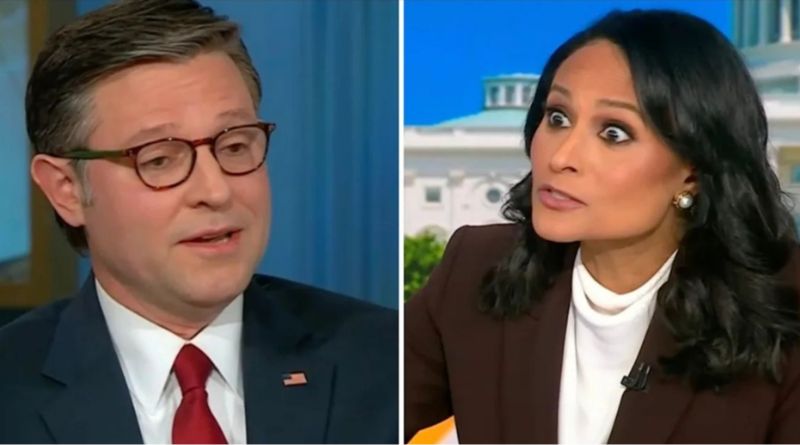

House Speaker Mike Johnson (R-La.) stated this week that he supports certain federal immigration enforcement reforms that are also backed by Democrats but called on his colleagues to come together to end the partial government shutdown.
“Some of these conditions and requests that they’ve made are obviously reasonable and should happen. But others are going to require a lot more negotiation,” Johnson told host Kristen Welker on NBC’s “Meet the Press.”
Senate Democratic Leader Chuck Schumer proposed several measures, including prohibiting roving federal immigration enforcement patrols, expanding warrant requirements for federal law enforcement, establishing a universal code of conduct for federal officers, and banning officers from wearing masks during operations.
“These are commonsense reforms,” Schumer said. “If Republicans refuse to support them, they are choosing chaos over order, plain and simple.”
Schumer did not, however, address Democratic lawmakers’ gaslighting of ICE and Border Patrol agents, claiming they were akin to “Nazis” and “Gestapo,” with some labeling them “Trump’s secret police.”
Schumer also did not address the party’s efforts to whip up opposition to immigration enforcement efforts nationwide.
Johnson expressed his support for banning roving patrols and requiring federal immigration officers to wear body cameras. But the Speaker said that officers wear masks “to protect their own identities and protect their own families” and argued that expanding warrant requirements would add a “whole other layer of, effectively, bureaucracy” for immigration enforcement.
“I really hope that everybody will come to the table in good faith,” he noted on the DHS negotiations. “That’s what’s going to be required here.”
An email obtained by Federal News Network says that tens of thousands of federal workers at U.S. Customs and Border Protection will still get paid even though the Department of Homeland Security is currently short-funded.
CBP, which is part of DHS, plans to use extra money from the One Big Beautiful Bill Act to keep paying the more than 57,600 agency workers who have been working during this month’s partial shutdown. Federal News Network obtained an email this week from the National Treasury Employees Union, providing further details about the agency’s decision.
As long as the government remains shut down, CBP will “exempt” and pay many of its employees, including police officers and some civilian agency workers. However, some other CBP workers remain “excepted,” meaning they will not receive payment until the shutdown concludes.
CBP’s plans for a shutdown indicate that it will impact this group of approximately 63,200 employees. Based on CBP’s recent decision to grant exemptions, that means that about 5,600 workers will have to keep working without pay until the shutdown ends.
A 2019 law stipulates that upon the restoration of congressional appropriations, all excepted and furloughed federal workers will receive their back pay.
The OBBBA money that was set aside for DHS last year wasn’t specifically marked for operations or salaries, but the Trump administration did something very unusual last fall and decided to use some of that money to pay some employees.
During the 43-day funding lapse last fall, the administration kept paying 70,000 federal law enforcement officers, including CBP officers, with money from the bill. Many civilian employees continued to work without pay during this time.
The current DHS-only shutdown started on February 14 because Congress couldn’t agree on changes to how immigration enforcement works before the deadline for appropriations.
About 90% of the more than 260,000 DHS workers are still going to work during the current agency shutdown. This group includes many who are “excepted” and working without pay. That includes Coast Guard civilians and people who work for the Transportation Security Administration, FEMA, and the Cybersecurity and Infrastructure Security Agency.
DHS workers, on the other hand, will soon receive a partial paycheck for the current pay period. This will cover the hours they worked before the shutdown began. Should the shutdown extend into March, the affected workers will experience their first pay delay in a long time.
Related Posts