
The U.S. Supreme Court on Friday blocked President Donald Trump from using an emergency law to impose high tariffs on most U.S. trading partners without the consent of Congress. The president suffered a significant setback in a case concerning one of his primary economic policies, which he deemed crucial for the U.S. economy.
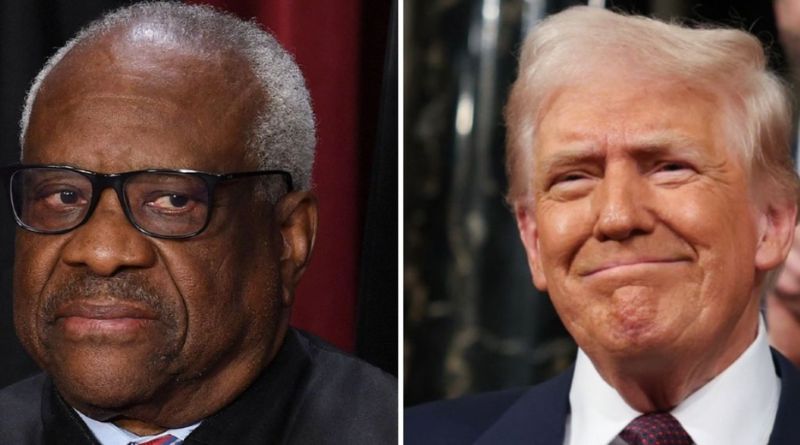
The justices ruled 6-3 that Trump’s tariffs were not valid. Justices Brett Kavanaugh, Samuel Alito, and Clarence Thomas disagreed.
Supreme Court Justice Clarence Thomas sounded off in his dissent.
“Neither the statutory text nor the Constitution provides a basis for ruling against the President. Congress authorized the President to ‘regulate . . . importation.’ Throughout American history, the authority to ‘regulate importation’ has been understood to include the authority to impose duties on imports,” Thomas declared.
“The meaning of that phrase was beyond doubt by the time that Congress enacted this statute, shortly after President Nixon’s highly publicized duties on imports were UPHELD based on identical language. The statute that the President relied on, therefore, authorized him to impose the duties on imports at issue in these cases,” Thomas added.
Thomas continued, “Because the Constitution assigns Congress many powers that do not implicate the nondelegation doctrine, Congress may delegate the exercise of many powers to the President. Congress has done so repeatedly since the founding, with this court’s blessing.”
In addition, George Washington University Law School professor and legal scholar Jonathan Turley said this isn’t over. The administration can still impose tariffs through other statutes.
“The administration has other tools in its toolbox. It can actually impose tariffs under other statutes,” Turley said, adding that there’s plenty of runway for the Trump White House in this area of economic policy.
Justice Thomas cooks the majority with his dissent in today's tariff decision
"Congress authorized the President to 'regulate… importation.' Throughout American history, the authority to 'regulate importation' has been understood to include the authority to impose duties on… pic.twitter.com/QB5Cw7AZKa
— Breitbart News (@BreitbartNews) February 20, 2026
🚨 JUST IN: Legal expert Jonathan Turley confirms Trump has a MASSIVE TOOLBOX of additional tariff options, the 6-3 SCOTUS ruling is NOT the end of the road
"The admin has other tools…it can impose tariffs under other statutes."
MAKE IT HAPPEN!pic.twitter.com/WwjQD62kO3
— Eric Daugherty (@EricLDaugh) February 20, 2026
Justice Brett Kavanaugh raised in a fiery dissent what he said would be “serious practical consequences” of the high court’s decision in terms of refunding illegitimately imposed tariffs. The majority did not address refunds, an issue now likely to be raised in lower courts.
“The United States may be required to refund billions of dollars to importers who paid the IEEPA tariffs, even though some importers may have already passed on costs to consumers or others,” Kavanaugh wrote. “As was acknowledged at oral argument, the refund process is likely to be a ‘mess.’”
Lawyers for the Trump administration have argued in lower courts that the IEEPA allows a president to act in response to “unusual and extraordinary threats” and in cases where a national emergency has been declared.
Trump says that deep and “sustained” trade deficits are a national emergency that is bad enough to let him use his emergency powers.
The DOJ asked the Supreme Court to keep the tariffs in place, saying that not giving Trump the power to set tariffs under IEEPA “would leave our country open to trade retaliation without effective defenses.”
Plaintiffs said that no president has ever used the law to impose tariffs in the 50 years since it was passed. They also said that the trade deficit Trump talked about has been going on for almost 50 years, which they said goes against his claim that there is an “unusual and extraordinary” trade emergency.
They said that letting Trump use IEEPA to keep his universal tariffs would give the executive branch a lot more power at the expense of the other branches of government.
Last year, all three judges on the U.S. Court of International Trade agreed to stop Trump’s tariffs from going into effect.
They said that as commander-in-chief, Trump does not have “unbounded authority” to impose tariffs under the emergency law.
The U.S. Court of Appeals for the Federal Circuit also rejected the administration’s use of IEEPA.