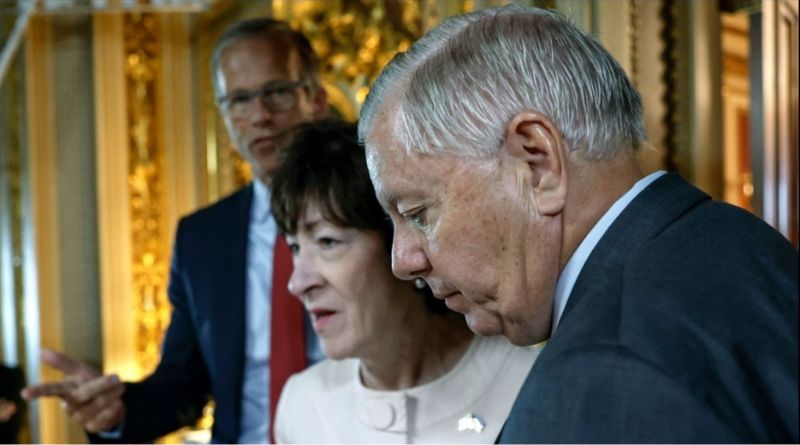

A key Republican senator has agreed to back a national voter ID measure passed by the House last week and favored by President Donald Trump, but with a caveat. Sen. Susan Collins, R-Maine, said she will support the Safeguard American Voter Eligibility Act, known as the SAVE Act, after weeks of uncertainty about her position.
Collins confirmed her support in a statement to the Maine Wire on Friday, bringing the number of Republican senators backing the bill to 50. However, under current Senate rules, the measure would need the support of some Democrats to reach the 60-vote threshold to become filibuster-proof.
Sen. Lisa Murkowski, R-Alaska, has announced she will oppose the bill. Sens. Mitch McConnell, R-Ky., and Thom Tillis, R-N.C., who have both announced they will not seek reelection, have not publicly endorsed the legislation despite previously expressing support for voter identification requirements.
Collins had previously expressed reservations about earlier versions of the SAVE Act.
Speaking with reporters on Feb. 11, she said she was reviewing the bill and supported many of its provisions but had concerns about language requiring voters to present citizenship documents each time they cast a ballot.
“Requiring voters to produce passports or birth certificates on election day, as opposed to just a state-issued ID, would have placed an unnecessary burden on the voters,” Collins said at the time, adding that changes to that provision could earn her support.
In her Friday statement, Collins said she believes the revised legislation addresses those concerns.
“The law is clear that in this country only American citizens are eligible to vote in federal elections,” she said. “In addition, having people provide an ID at the polls, just as they have to do before boarding an airplane, checking into a hotel, or buying an alcoholic beverage, is a simple reform that will improve the security of our federal elections and will help give people more confidence in the results.”
Collins also said she does not support eliminating or weakening the legislative filibuster in order to pass the measure.
Trump and other Republicans have urged Senate Majority Leader John Thune, R-S.D., to consider restoring what is known as the “standing” or “talking” filibuster as a way to move the legislation forward.
Under a standing filibuster, senators opposing a bill must hold the floor and continue debate to block it, rather than relying on the current 60-vote threshold required to end debate.
Thune has pledged to bring the SAVE Act to the Senate floor and has said discussions about procedural options are ongoing.
“I oppose eliminating the legislative filibuster,” Collins said. “The filibuster is an important protection for the rights of the minority party, that requires Senators to work together in the best interest of the country. Removing that protection would, for example, allow a future Congress controlled by Democrats to pass provisions on anything they want.”
The SAVE Act would require proof of U.S. citizenship to register to vote in federal elections and has become a priority for Republicans who argue it would strengthen election integrity.
Trump said Friday that voter identification requirements will be in place for the November 2026 midterm elections, regardless of whether Congress approves legislation to impose them.
Trump’s remarks came amid ongoing debate over the SAVE America Act. The bill would require voters to provide proof of U.S. citizenship at registration and to show photo identification when casting a ballot.
In a post on his social media platform, Trump pledged that “there will be voter I.D. for the midterm elections, whether approved by Congress or not.”
“The Democrats refuse to vote for Voter I.D., or Citizenship. The reason is very simple — They want to continue to cheat in Elections. This was not what our Founders desired. I have searched the depths of Legal Arguments not yet articulated or vetted on this subject, and will be presenting an irrefutable one in the very near future,” Trump wrote.