Brutal Blow to the Experts: How President Trump’s Approval Rating Crushes Obama and Bush at the 306-Day Mark –
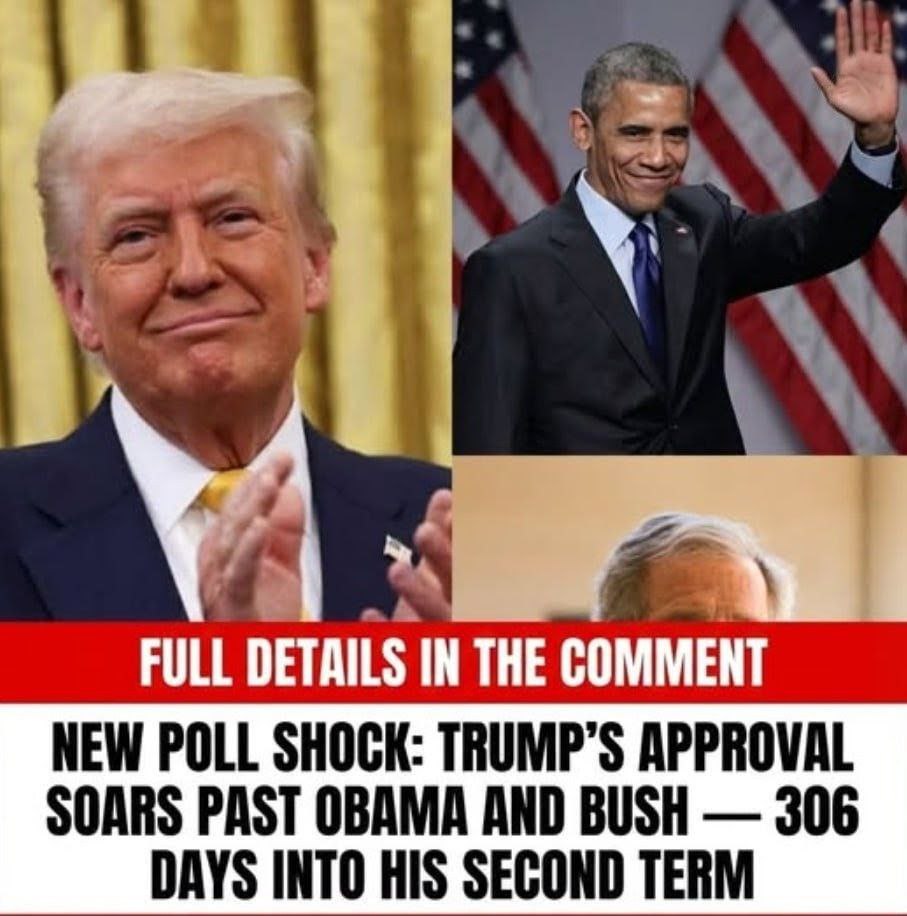
On a crisp autumn afternoon in late November 2025, as golden leaves danced across the White House lawn like fleeting promises, a simple poll number cut through the relentless hum of Washington like a clarion call from the heartland. President Donald J. Trump, now 306 days into his improbable second act, stood tall in the eyes of the American people with an approval rating averaging 42.5 percent, according to the RealClearPolitics aggregate that has become the gold standard for measuring a leader’s pulse. It was a figure that didn’t just hold steady amid the gales of controversy and economic headwinds; it eclipsed the marks set by his predecessors at the same precarious juncture—Barack Obama’s 40 percent in the waning days of 2013 and George W. Bush’s 38 percent through the fog of 2005. The news rippled outward from a viral post on X, where supporters hoisted it like a battle flag: “BRUTAL!” it proclaimed, a gleeful jab at the pundits who’d long dismissed Trump as a fleeting flame. But beyond the bravado, this milestone whispered a deeper truth about resilience, about a nation still grappling with its scars and dreams, where one man’s unyielding grin could summon cheers from the faithful even as skeptics shook their heads in quiet disbelief.

Imagine the scene in a bustling diner off Route 66 in Missouri, where truckers nursing black coffee and retirees flipping through dog-eared newspapers paused mid-sip to absorb the headline on their phones. For them, it wasn’t abstract arithmetic; it was vindication, a nod to the grit that carried Trump through impeachments, indictments, and an assassination attempt that left the world holding its breath on a Pennsylvania stage just over a year prior. Trump’s journey back to the Oval Office had been nothing short of epic—a comeback forged in the fires of 2024’s razor-wire election, where he clinched 312 electoral votes and a popular plurality that silenced the chorus of “never again.” Sworn in on January 20, 2025, amid vows to “make America thrive again,” he wasted no time: slashing regulations with the stroke of a pen, brokering energy deals that promised cheaper gas at the pump, and staring down global adversaries with the same brash stare that once filled arenas to the rafters. Yet, as spring bloomed into summer, the honeymoon haze lifted, revealing the jagged edges of governance in a polarized age. Inflation ticked upward, stubborn as a summer storm, while whispers from newly unsealed Jeffrey Epstein files cast long shadows over old alliances, testing the loyalties of even his staunchest defenders.

By November, the air was thick with the scent of change—or stagnation, depending on the lens. Nate Silver’s meticulously curated tracker, a beacon for data-driven souls, pegged Trump’s approval at 42 percent, a net negative of 14 points but a defiant perch above the historical troughs his rivals had plumbed. Reuters/Ipsos, ever the unflinching mirror, clocked in slightly lower at 38 percent in a mid-November survey, capturing the raw sting of grocery bills that climbed 4.2 percent year-over-year and the unease rippling through suburban soccer fields where parents fretted over college funds. These weren’t just dips; they were the human toll of a world still reeling from supply-chain snarls and geopolitical tremors, from Ukraine’s endless grind to China’s economic shadow-boxing. Trump’s response? A flurry of executive actions—tax rebates for middle-class families, a “Buy American” blitz that juiced manufacturing jobs by 250,000 in the first nine months—and a relentless social media blitz that kept his base fired up like embers in a hearth. “The fake news says we’re down, but the people know better,” he quipped at a rally in Phoenix, his voice booming over a sea of red hats, drawing roars that drowned out the distant thunder of criticism.
To grasp the weight of this 42.5 percent, one must journey back to the parallel paths of those who came before, men whose second terms began with fanfare only to stumble into the quicksand of midterm malaise. Barack Obama, the silver-tongued orator who swept into 2009 on waves of hope, found his second chapter shadowed by the Affordable Care Act’s rocky rollout and a sluggish recovery from the Great Recession. By November 22, 2013—exactly 306 days into that term—Gallup’s daily tracking had his approval hovering at 40 percent, a slide from the 51 percent high of his inauguration month, as shutdowns and scandals chipped away at the aura of invincibility. Families in swing states like Ohio, still nursing foreclosed dreams, turned inward, their faith in Washington fraying like old denim. Obama, ever the professor-poet, leaned on empathy in town halls, his measured cadence a balm, but the numbers told a tale of quiet erosion, setting the stage for Democrats’ bruising 2014 midterms.

George W. Bush’s encore, launched amid the confetti of his 2004 triumph over John Kerry, crashed against the unyielding wall of Iraq’s insurgency and Katrina’s fury. Inaugurated on January 20, 2005, Bush promised compassionate conservatism, but by that fateful 306th day, his Gallup approval had dipped to 38 percent, battered by mounting casualties overseas and whispers of overreach at home. In living rooms from Dallas to Des Moines, the evening news became a ritual of sorrow, parents clutching photos of sons and daughters lost to a war that once seemed winnable. Bush, the folksy Texan with a squint that spoke of resolve, pressed on with Social Security reforms that went nowhere, his rancher’s drawl steady even as polls mirrored the nation’s weary sigh. Like Trump, he faced a media machine that amplified every misstep, but unlike the 45th president, Bush’s dip foreshadowed a steeper fall, culminating in a 2006 wave that flipped Congress to Democrats.
What sets Trump’s tally apart isn’t mere math; it’s the alchemy of personality in a fractured republic. At 42.5 percent, he threads the needle between adoration and alienation, commanding 87 percent approval among Republicans—down a tick from summer peaks but a fortress nonetheless—while independents waver at 39 percent, per the latest Economist/YouGov survey. Democrats? A glacial 8 percent, a chasm that underscores the tribal trenches dug deeper by years of trench warfare. Yet, in this divide lies Trump’s secret sauce: an unapologetic authenticity that resonates like a heartbeat in the rust belt towns he reclaimed. Take Sarah Jenkins, a 52-year-old welder from Youngstown, Ohio, whose story echoes millions. Laid off in 2019, she voted for Biden in a haze of pandemic fear, only to watch prices soar and borders strain. Trump’s return brought her a factory job via his “America First” incentives, and now, over coffee in a union hall, she confesses a reluctant nod: “I didn’t think I’d say it, but he’s delivering where it hurts.” Her words, captured in a recent Pew focus group, capture the quiet shift—not euphoria, but a pragmatic thaw that buoys those numbers above the Obama-Bush baseline.

Of course, no presidency is a straight-line saga, and Trump’s second term brims with plot twists that tug at the nation’s conscience. The Epstein files, unsealed in batches through October 2025 under court order, unleashed a torrent of scrutiny that even the most loyal couldn’t ignore. Revelations of high-profile ties—naming figures from Hollywood to Wall Street—splashed across front pages, with Trump’s past acquaintanceship with the financier resurfacing like a ghost at a feast. A Reuters/Ipsos poll from November 14-17 found just 20 percent of Americans approving his handling of the fallout, a stark 44 percent among his own party, prompting a rare pivot: Trump, who’d once dismissed the probe as “witch hunt 2.0,” greenlit a DOJ task force to pursue unredacted leads, a move hailed by allies as bold transparency but decried by foes as damage control. Layer on the economy’s stubborn ache—inflation at 3.1 percent, gas averaging $3.45 a gallon—and you see the cracks: a 5-point approval drop on economic stewardship since July, per Fox News, as families stretch paychecks thinner than a politician’s promise.
Yet, here’s the resilient heartbeat of it all: Trump endures. His border security rating holds at 45 percent in that same Fox survey, a lifeline tossed to voters weary of migrant surges that peaked at 2.5 million encounters in fiscal 2025 before his wall expansions and asylum curbs took hold. Foreign policy gleams brighter still—68 percent approval on Israel aid post-October 7 echoes, and a Ukraine deal brokered in Geneva that froze lines without new billions—reminders that this is a commander who plays chess while others play checkers. As midterms loom in 2026, with Republicans defending a slim House majority and eyeing Senate gains, these metrics aren’t footnotes; they’re fuel. House Speaker Mike Johnson, fresh from a whip count on tax cuts, told reporters in a Capitol hallway, “The president’s standing with the people who matter—working folks tired of the elite lecture.” Democrats, regrouping under Hakeem Jeffries, counter with ads painting Trump as “yesterday’s chaos,” but their own internal polls show independents drifting right by 3 points since Labor Day.
In the quiet hours, away from the roar, this approval edge evokes a poignant American archetype: the underdog who rises, bloodied but unbroken. Trump, at 79, moves with the vigor of a man half his age, golfing Mar-a-Lago mornings before diving into briefings that stretch till dusk. Melania, ever the poised sentinel, shares glimpses of family life—a grandson’s birthday, a holiday menu tweaked for tradition—that humanize the titan. And across the aisle, even critics like former Obama advisor David Axelrod concede in podcasts: “He’s got that fighter’s instinct; it’s why the numbers stick.” For the diner patrons in Missouri, the welder in Ohio, the single mom in Atlanta juggling shifts and school runs, 42.5 percent isn’t a statistic—it’s a signal that their voices, often drowned in coastal clamor, still echo in the halls of power.
As Thanksgiving tables groan under turkey and gratitude, this milestone lands like a timely grace note. It defies the experts who pegged Trump’s return as electoral suicide, the historians who drew parallels to faded second acts. Instead, it charts a course through turbulence, reminding us that leadership isn’t polls alone but the stories they tell—of perseverance amid plenty, of a people who, in their bones, crave competence over charisma. Will the winter bring fresh frosts—perhaps a debt ceiling showdown or tariff tremors? Undoubtedly. But on this 306th day, as the sun dips low over Pennsylvania Avenue, President Trump claims another win, not with fanfare but with the steady gaze of a survivor. In America’s grand, messy narrative, that’s the real brutal truth: the fight goes on, and so does the faith.
Related Posts