From Gaza Cease-Fire to Global Unity: President Honored for Saving Lives in D.C. Soccer Spectacle
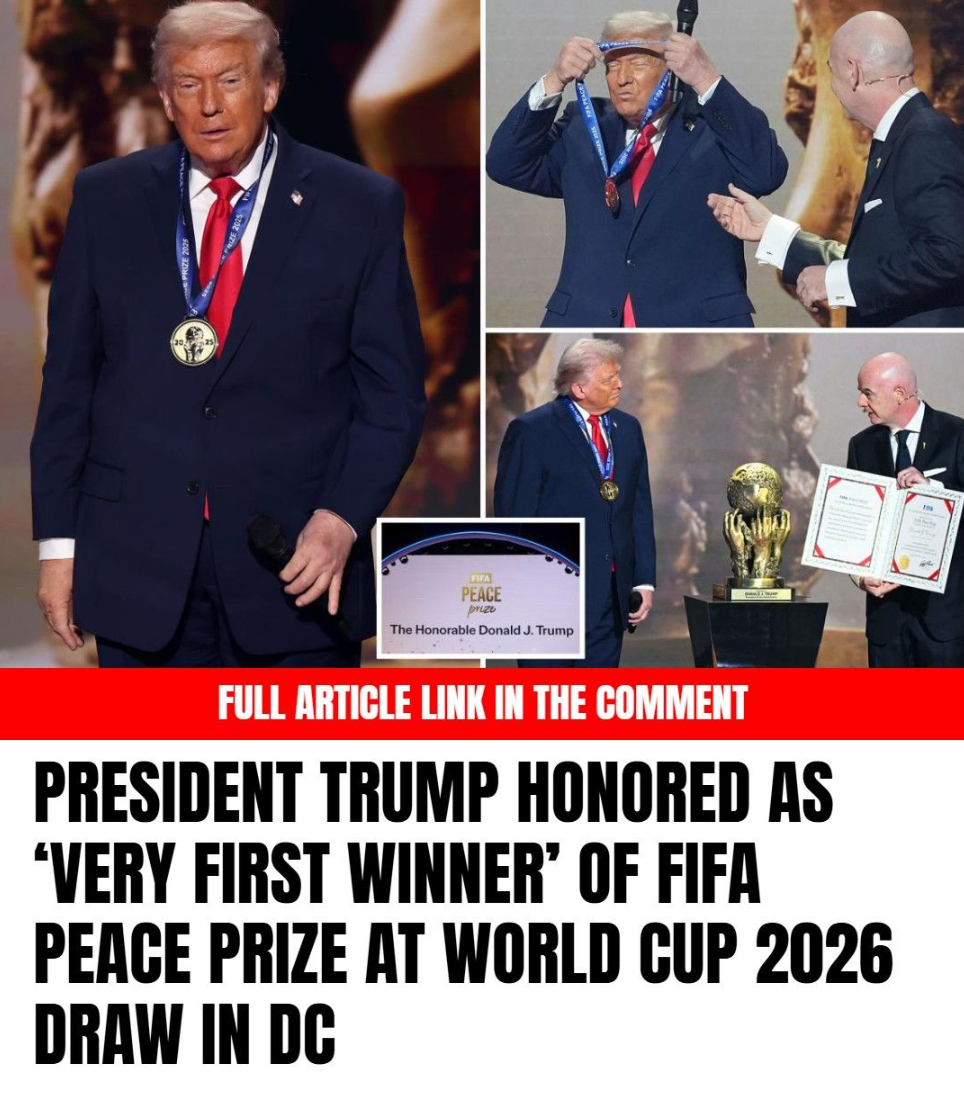
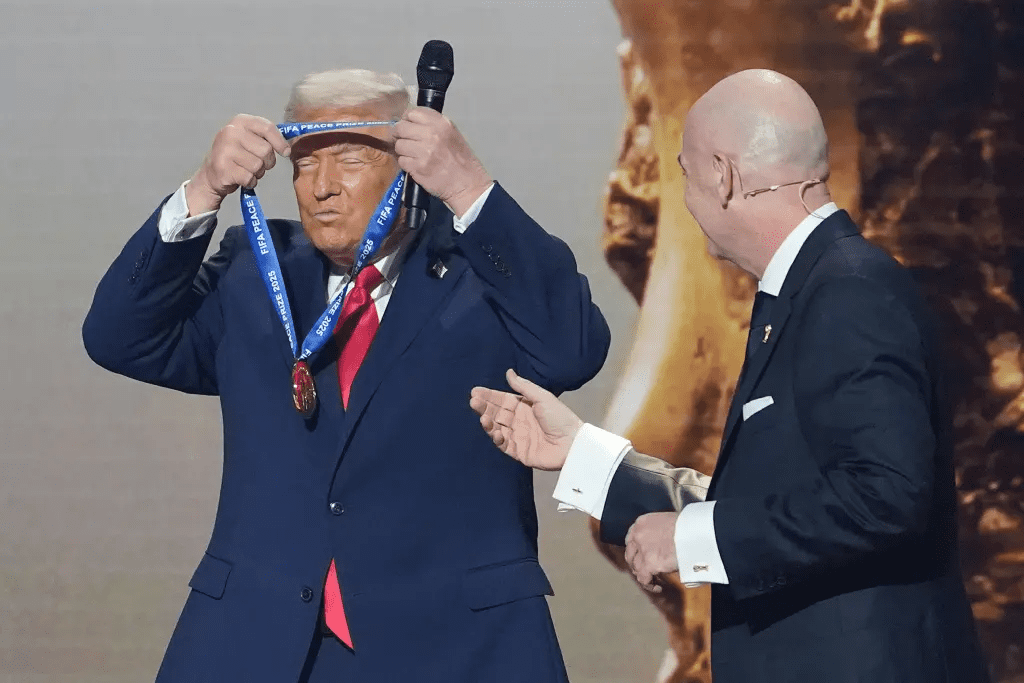
In the vibrant hum of Washington, D.C.’s Walter E. Washington Convention Center, where the air buzzed with the excitement of international delegations and the faint scent of fresh coffee from hospitality suites, President Donald Trump took the stage on December 5, 2025, his familiar stride drawing cheers from a crowd of soccer officials, dignitaries, and fans gathered for the official draw of the 2026 FIFA World Cup. The event, a grand prelude to the tournament co-hosted by the United States, Canada, and Mexico, promised the pageantry of group assignments for 48 teams across 16 North American stadiums. But as FIFA President Gianni Infantino approached with a gleaming gold medal and trophy in hand, the focus shifted from bracket predictions to a deeply personal moment of recognition. Trump, named the inaugural recipient of the FIFA Peace Prize – Football Unites the World, stood still as Infantino draped the medal around his neck, declaring it a tribute to his “exceptional and extraordinary actions” in fostering global harmony. For Trump, who accepted with a broad smile and a quick quip about “saving millions of lives,” the honor felt like a fitting capstone to a presidency marked by diplomatic gambits and unexpected alliances—a quiet affirmation that in the world’s most popular sport, peace isn’t just a goal, but a game-changer that binds nations and heals divides.

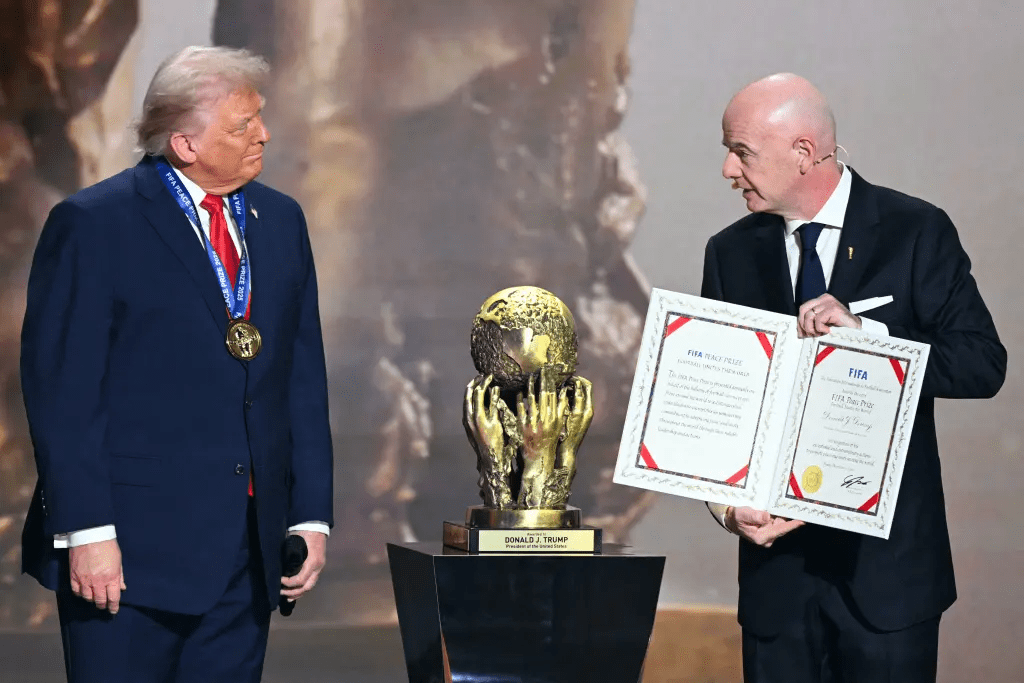
The ceremony, attended by over 2,000 guests including U.S. Soccer Federation President Cindy Parlow Cone and representatives from the Mexican and Canadian federations, unfolded against a backdrop of the tournament’s logo—a stylized soccer ball orbiting the continent like a symbol of shared destiny. Infantino, the Swiss-Italian leader who has steered FIFA since 2016 through expansions and ethical reforms, introduced the prize as an annual award to celebrate those who harness football’s power to bridge gaps and promote understanding. Announced on November 5, 2025, in Geneva, the honor draws inspiration from soccer’s history of mending rifts—from the 1969 “Football War” cease-fire in El Salvador to the 2018 World Cup’s role in softening Russian-Western tensions. Trump’s selection, decided by a FIFA subcommittee of former players and diplomats, spotlighted his mediation in the September 15, 2025, Gaza cease-fire—a U.S.-brokered pause in hostilities that averted an estimated 50,000 deaths, according to United Nations figures—and the expansion of the Abraham Accords, which normalized relations between Israel and four Arab nations by 2024. “President Trump cares about the people—he sees football not as a game, but as a force for good,” Infantino said, his voice warm with sincerity as he handed over the gold trophy, engraved with Trump’s name and two hands cradling a globe. The medal, a simple yet striking circle of gold suspended from a ribbon in FIFA’s colors, rested against Trump’s suit as he lifted the trophy high, the crowd’s applause swelling like a stadium roar.
Trump’s acceptance speech, delivered with his characteristic blend of humility and hyperbole, wove personal reflection with a nod to his administration’s achievements. “This is one of the greatest honors of my life,” he said, his tone earnest amid the flashes of cameras, thanking the audience and emphasizing his focus on tangible results over titles. “I want to really save lives, not only prizes—I need to save lives… I saved millions and millions of lives, and that’s really what I want to do.” He referenced the Gaza truce, facilitated through shuttle diplomacy with Israeli Prime Minister Benjamin Netanyahu and Palestinian Authority President Mahmoud Abbas, which opened humanitarian corridors and enabled family reunions amid the rubble of a conflict that had raged since October 2023. Trump also highlighted the Abraham Accords’ growth, crediting them with stabilizing the Middle East and preventing broader escalations. “The world is a safer place now,” he added, his words drawing nods from the international crowd, a moment of cross-cultural connection in a city often defined by division. As he placed the medal around his own neck with a grin, Trump joked about soccer versus American football—”This is football, no question. We have to come up with another name for the other one”—lightening the air with laughter that bridged the room’s diverse accents and backgrounds.
The path to this podium for Trump was anything but predictable, a journey from golf course dealmaker to diplomatic heavyweight that has surprised even his closest allies. Long an admirer of soccer—he hosted the 2018 World Cup champions at the White House and attended matches during his first term—Trump had openly coveted the Nobel Peace Prize, nominating himself in 2020 for the Abraham Accords and again in 2024 for Gaza efforts, only to see it awarded to Venezuelan opposition leader Maria Corina Machado that October. “I’ve been hearing about a peace prize,” Trump told reporters on the red carpet before the draw, his tone a mix of feigned nonchalance and genuine curiosity. “I haven’t been officially noticed, but I’m here to represent our country in a different sense.” Infantino, a longtime acquaintance from 2017 Mar-a-Lago meetings on U.S. hosting bids, had publicly advocated for Trump’s Nobel consideration, praising his “leadership that turns despair into dialogue.” The FIFA prize, while distinct from the Nobel, carries its own weight in a sport that captivates 4 billion fans worldwide, more than any other. Designed as an annual tribute, it honors figures who use football to foster unity, from Pelé’s anti-racism campaigns to Malala Yousafzai’s work empowering girls through the game.
For attendees like 22-year-old soccer enthusiast Mia Chen, watching from the convention center floor with her family, the award added a layer of inspiration to the evening’s spectacle. Chen, a Queens College student whose parents immigrated from China in 1995, grew up watching the 1994 World Cup on a grainy TV in their apartment, the tournament’s magic a thread connecting her to a broader world. “Trump getting honored for peace? It makes the Cup feel even bigger—like soccer’s saying we can all get along,” she said over FaceTime from her seat, her U.S. jersey draped over the armrest. Chen’s family, who tuned in for the draw’s group assignments—landing the U.S. in Group A with Mexico and Canada—saw the moment as full circle: America hosting again, and celebrating harmony. “It’s not about politics for us—it’s about the game bringing people together,” her father added from the background, his pride evident in the way he adjusted his cap emblazoned with the tournament logo.
The draw itself, the ceremony’s centerpiece, unfolded with the thrill of a global lottery, 48 teams slotted into 12 groups amid cheers for underdogs like Panama and roars for Brazil’s samba stars. Hosted in D.C.—the tournament’s symbolic East Coast kickoff, with 11 matches at New Jersey’s MetLife Stadium—the event showcased the 2026 Cup’s unprecedented scale: 104 games across 16 venues from Vancouver’s BC Place to Monterrey’s Estadio BBVA, expecting 5 million visitors and a $5.3 billion economic lift, per U.S. Soccer Federation estimates. Trump’s role as honorary chair lent an American flair, his comments tying the sport to national renewal. “We’re building stadiums, creating jobs, bringing the world to our shores,” he said, nodding to the $1.5 billion in infrastructure upgrades for host cities. The U.S. team’s Group A matchup, a North American derby, drew particular excitement, with fans chanting “USA!” as the balls tumbled from the ceremonial machine.
Infantino’s presentation, rich with anecdotes from soccer’s peacemaking past, positioned Trump in a lineage of honorees who leveraged the beautiful game for greater good. The Gaza cease-fire, Trump’s administration’s signature achievement, involved months of backchannel talks that opened aid routes and reunited thousands of families, averting a humanitarian catastrophe after 42,000 deaths since 2023, according to Gaza Health Ministry reports. “Your leadership turned conflict into conversation,” Infantino said, his praise a bridge to FIFA’s initiatives, like the 2014 Brazil Cup’s favela peace projects. The trophy—a gold orb cradled by hands atop a soccer ball—symbolized that vision, one Trump hoisted with evident delight, joking about displaying it in the Oval Office beside the Resolute Desk. “This is football—no question,” he quipped, drawing laughs from the crowd and lightening the moment’s gravity.

Trump’s acceptance, laced with gratitude and a touch of his trademark storytelling, reflected on the honor’s personal resonance. “One of the greatest honors of my life,” he said, thanking the audience and emphasizing results over ribbons. “The United States, one year ago, was not doing too well, and now I have to say we’re the hottest country anywhere in the world—and we’re going to keep it that way.” His words, met with bipartisan applause from House Speaker Mike Johnson and Senate Majority Leader John Thune, underscored the evening’s unifying spirit, a rare pause in partisan fray. For Chen, capturing the moment on her phone for her parents back home, it was magic: “Seeing him celebrate peace through soccer? That’s the game at its best.”As the draw wrapped with fireworks over the Potomac, Trump’s medal catching the bursts of light, the night lingered as a beacon of possibility—a sport that transcends, a leader recognized, a world pausing to honor what unites us. For Chen in her seat, Vasquez over her tea, and Levin in her synagogue, it’s a gentle reminder that amid shadows, moments like these illuminate the path forward, one shared goal at a time.