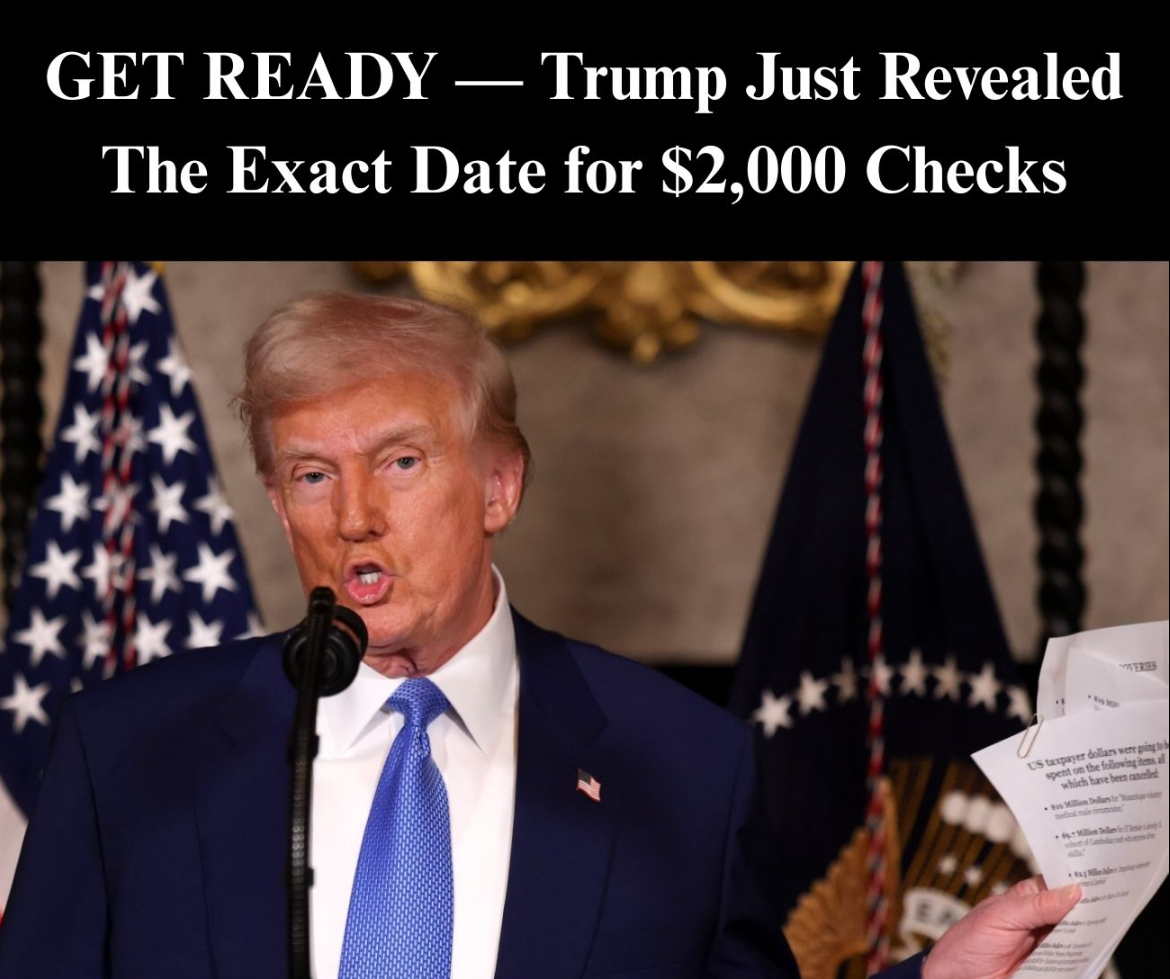

As the 2026 elections draw near, discourse persists regarding President Donald Trump’s proposal to distribute $2,000 stimulus checks funded by tariffs. Trump stated that the rebates would be allocated to low- and middle-income Americans in mid-to-late 2026, funded by revenue from his extensive import tariffs.
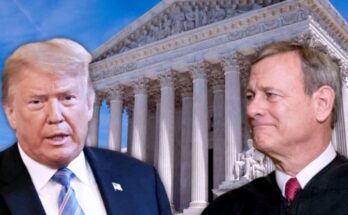
Numerous challenges persist, including an impending U.S. Supreme Court case that will ascertain the legality of the tariffs, ambiguity regarding the adequacy of tariff revenue to finance substantial payments, and the necessity for congressional approval, as reported this week.
Despite Trump’s public endorsement of the concept since July, there is no guarantee that the plan will be executed. Certain Republican legislators have voiced concerns, interrogating the viability of the proposal and its likelihood of success in Congress.
Ohio Senator Bernie Moreno has expressed a preference for directing tariff revenue towards alleviating the nation’s approximately $38 trillion debt instead of distributing rebate checks.
Numerous officials from Trump’s administration have commented on the suggested tariff rebate initiative. Treasury Secretary Scott Bessent proposed an income threshold of $100,000 for eligibility, whereas Commerce Secretary Howard Lutnick has advocated for the notion of stimulus payments.
Recently, White House economic adviser Kevin Hassett indicated that the proposal’s future is ambiguous. During an appearance on Face the Nation with Margaret Brennan, Hassett stated that the plan’s outcome “depends on what transpires with Congress.”
“The deficit compared to last year has decreased by $600 billion. Initially, I was uncertain about the feasibility of such a check, but I am now confident that it is possible. Therefore, I anticipate that in the new year, the President will present a proposal to Congress to facilitate this,” stated Hassett, director of the White House’s National Economic Council, during the interview on December 21.
Congress must formulate and enact legislation to allocate funding for the proposed stimulus checks, as indicated by an independent tax policy organization. The Tax Foundation estimates the cost to range from $279.8 billion to $606.8 billion.
The organization anticipates that Trump’s tariffs will yield approximately $207.5 billion in revenue by 2026, alongside an estimated $205 billion accrued through October of this year, with further revenue expected in the remaining months of 2025.
In his appearance on Face the Nation with Margaret Brennan, Hassett stated that financing for any rebate program could derive from sources beyond merely tariff revenue. “It may originate from tariff revenue, but ultimately, we receive taxes, tariffs, and revenue from various sources, after which Congress determines the allocation of those funds,” he remarked. “That constitutes appropriation.”
Trump has reaffirmed that the $2,000 payments are still anticipated, stating they will likely be allocated to eligible Americans “probably in the middle of next year.”
“We will be distributing dividends later, likely in the middle of next year or slightly thereafter.” The president stated on November 17, as reported by Axios, “Thousands of dollars for individuals of moderate and middle income.”
Earlier this month, he declared in a nationwide address that military personnel would receive bonuses of $1,776, termed “Warrior Dividends,” by year-end, attributing the funding to tariff revenue.
In his address, Trump suggested that the bonuses had been anticipated for an extended period but had remained undisclosed.
“In conjunction with the recently enacted Big Beautiful bill, I am also pleased to announce that over 1,450,000 military service members will receive a special benefit, referred to as the warrior dividend, prior to Christmas,” Trump stated.
“In commemoration of our nation’s establishment in 1776, we are disbursing $1776 to each soldier. Contemplate that. The checks are already en route. No one comprehended that until approximately 30 minutes ago,” he remarked.